1.1
Bird's Nest
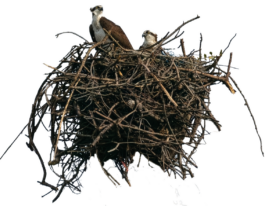
Osprey nest (Pandion haliaetus), date unknown
Primary image used to model a bird’s nest for the sculpture. This image associated with the bird committee at Palmetto Hall, a golf club in South Carolina and bird sanctuary, is part of the work documentation for a platform intended to be used by nesting ospreys. Photograph: Linda O’Rourke
This bird’s nest seen in the sculpture is made of twigs found in and around Duivendrecht that are then cast in bronze. It is loosely modelled after the various nests of the osprey by prominent sound artist André Avelās (a reliable authority on birds, if not on nesting habits more generally).
Ospreys construct large, enduring nests that can be used for decades. Each spring, a pair — often long-term partners — returns to the same site, typically a high perch such as the top of a dead tree, cliff, or human-made platform near water. The male usually arrives first, bringing sticks to the chosen spot, with the female joining soon after to arrange and shape the structure.
The nest begins with a foundation of coarse branches, gradually refined with smaller twigs, grasses, and other plant matter to form a deep cup. The interior is lined with softer material such as moss, bark, or seaweed, and ospreys are known to incorporate found objects — plastic, rope, or cloth — into their nests. Building takes one to two weeks, though returning pairs mainly repair and expand existing structures each year. Over time, repeated additions cause the nest to grow to more than two metres across and a metre deep, sometimes weighing several hundred kilograms.
This process of annual renewal creates a lasting architectural form — an evolving accumulation of effort and memory — essentially landmarks in the landscape.
The “Adopted Infrastructure” phenomenon: Ospreys have a strong preference for the highest available point, which has led them to repeatedly build on cell phone towers, stadium lights, harbour cranes, and utility poles. In many coastal towns in the US and Northern Europe, workers now pre-emptively build decoy nesting platforms beside critical infrastructure — knowing full well the birds will ignore them unless they are slightly higher than the original pole.
1.1
Bird's Nest
Osprey nest (Pandion haliaetus), date unknown
Primary image used to model a bird’s nest for the sculpture. This image associated with the bird committee at Palmetto Hall, a golf club in South Carolina and bird sanctuary, is part of the work documentation for a platform intended to be used by nesting ospreys. Photograph: Linda O’Rourke
This bird’s nest seen in the sculpture is made of twigs found in and around Duivendrecht that are then cast in bronze. It is loosely modelled after the various nests of the osprey by prominent sound artist André Avelās (a reliable authority on birds, if not on nesting habits more generally).
Ospreys construct large, enduring nests that can be used for decades. Each spring, a pair — often long-term partners — returns to the same site, typically a high perch such as the top of a dead tree, cliff, or human-made platform near water. The male usually arrives first, bringing sticks to the chosen spot, with the female joining soon after to arrange and shape the structure.
The nest begins with a foundation of coarse branches, gradually refined with smaller twigs, grasses, and other plant matter to form a deep cup. The interior is lined with softer material such as moss, bark, or seaweed, and ospreys are known to incorporate found objects — plastic, rope, or cloth — into their nests. Building takes one to two weeks, though returning pairs mainly repair and expand existing structures each year. Over time, repeated additions cause the nest to grow to more than two metres across and a metre deep, sometimes weighing several hundred kilograms.
This process of annual renewal creates a lasting architectural form — an evolving accumulation of effort and memory — essentially landmarks in the landscape.
The “Adopted Infrastructure” phenomenon: Ospreys have a strong preference for the highest available point, which has led them to repeatedly build on cell phone towers, stadium lights, harbour cranes, and utility poles. In many coastal towns in the US and Northern Europe, workers now pre-emptively build decoy nesting platforms beside critical infrastructure — knowing full well the birds will ignore them unless they are slightly higher than the original pole.