5.4
Transmitters
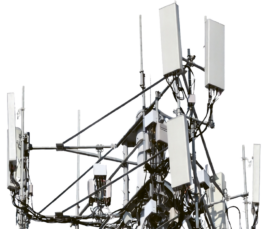
Cell tower in Richmond Hill, London, UK, 2020
A multi-sector cellular tower fitted with panel antennas, remote radio units, microwave backhaul dishes, mounting frames, and bundled power and fibre cabling. Photograph: Raysonho, source: Open Grid Scheduler / Scalable Grid Engine
Conspiracy theories surrounding radio and mobile-network transmitters have circulated in the US for decades, but gained renewed momentum with the rollout of 5G technology between 2018 and 2021.
These narratives blend older anxieties — Cold War fears of mind-control experiments, misinterpreted electromagnetic-health research, and long-standing distrust of telecommunications companies — into claims that 5G towers cause cancer, weaken immune systems, or were responsible for spreading Covid-19.
None of these assertions are supported by scientific consensus. Reviews and assessments by the FCC, FDA, WHO, and independent research bodies find no causal link between regulated radio-frequency exposure and such health effects.
Despite this, the conspiracies flourished. The rapid densification of urban antenna networks, limited public familiarity with radio-frequency and millimetre-wave physics, and the climate of fear during the pandemic created fertile ground. Social-media platforms amplified the effect; politically polarised online communities and coordinated disinformation networks helped circulate US-origin narratives internationally.
European variants quickly followed. In the UK and Belgium, multiple 5G masts were set on fire in 2020 after rumours claimed they “activated” viral transmission. In France and Germany, similar theories circulated on Telegram and other platforms, often intertwined with anti-government sentiment and environmental concerns. The Netherlands was not exempt: in the spring of 2020, more than two dozen transmitter sites were vandalised or damaged by fire, including incidents in Amsterdam Nieuw-West and the wider Noord-Holland region. Dutch authorities linked these acts to clusters of online misinformation combining anti-5G narratives with pandemic-related frustration.
While unfounded, these episodes reveal a persistent tension: the rapid expansion of telecommunications infrastructure frequently outpaces public understanding, creating conditions in which technological uncertainty, distrust, and social stress can coalesce into conspiracy.
5.4
Transmitters
Cell tower in Richmond Hill, London, UK, 2020
A multi-sector cellular tower fitted with panel antennas, remote radio units, microwave backhaul dishes, mounting frames, and bundled power and fibre cabling. Photograph: Raysonho, source: Open Grid Scheduler / Scalable Grid Engine
Conspiracy theories surrounding radio and mobile-network transmitters have circulated in the US for decades, but gained renewed momentum with the rollout of 5G technology between 2018 and 2021.
These narratives blend older anxieties — Cold War fears of mind-control experiments, misinterpreted electromagnetic-health research, and long-standing distrust of telecommunications companies — into claims that 5G towers cause cancer, weaken immune systems, or were responsible for spreading Covid-19.
None of these assertions are supported by scientific consensus. Reviews and assessments by the FCC, FDA, WHO, and independent research bodies find no causal link between regulated radio-frequency exposure and such health effects.
Despite this, the conspiracies flourished. The rapid densification of urban antenna networks, limited public familiarity with radio-frequency and millimetre-wave physics, and the climate of fear during the pandemic created fertile ground. Social-media platforms amplified the effect; politically polarised online communities and coordinated disinformation networks helped circulate US-origin narratives internationally.
European variants quickly followed. In the UK and Belgium, multiple 5G masts were set on fire in 2020 after rumours claimed they “activated” viral transmission. In France and Germany, similar theories circulated on Telegram and other platforms, often intertwined with anti-government sentiment and environmental concerns. The Netherlands was not exempt: in the spring of 2020, more than two dozen transmitter sites were vandalised or damaged by fire, including incidents in Amsterdam Nieuw-West and the wider Noord-Holland region. Dutch authorities linked these acts to clusters of online misinformation combining anti-5G narratives with pandemic-related frustration.
While unfounded, these episodes reveal a persistent tension: the rapid expansion of telecommunications infrastructure frequently outpaces public understanding, creating conditions in which technological uncertainty, distrust, and social stress can coalesce into conspiracy.