5.2
Maypole
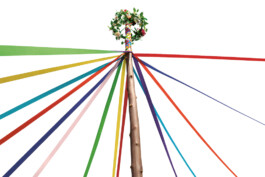
Maypole assembly, 2020
Consisting of a stripped wooden pole, floral wreath, and fabric ribbons, these elements are central to ritual dance and collective ornamentation. Photograph: John Kirkwood, source: “May Poles in November” article, John Kirkwood, acupressure.com.au
The maypole is one of Europe’s most persistent seasonal symbols, marking the return of spring and the renewal of communal life.
Its origins lie deep in pre-Christian agrarian rites, where the raising of a tall, freshly cut tree or wooden pole symbolised the reawakening of vegetation, fertility of the land, and the binding of community through ritualised labour.
By the Middle Ages, maypoles stood at the centre of village greens across Germanic and Nordic regions, often decorated with ribbons, wreaths, and carved emblems representing local guilds or families.
The nature of the maypole varies widely across Europe. In Germany and Austria, it is typically a tall, bark-stripped spruce erected on 1 May, often guarded overnight against being stolen by neighbouring villages. In England, the maypole became the locus of Morris dancing, ribbon-plaiting, and festive processions, with the pole symbolising communal vitality more than agricultural magic. In Scandinavia, particularly Sweden, the midsummer pole (midsommarstång) is decorated with leaves and flowers and raised during the June solstice, emphasising light and seasonal abundance.
The Dutch connection is quieter but historically present. In the Netherlands, maypoles (meibomen or meipalen) appear in early-modern records, especially in the eastern provinces and the coastal towns influenced by Germanic and Scandinavian customs. They were raised for village celebrations, guild festivals, and even as victory markers after municipal events. Amsterdam’s seventeenth-century painters recorded scenes with meibomen decorated with greenery during kermis (carnival) festivities.
The Dutch also preserved related customs, such as placing a decorated meiboom on newly completed buildings — a practice that survives today as the “topping out” ceremony (pannenbier), where a small tree or branch signals good fortune for the structure and its builders.
Across cultures, the maypole remains a potent emblem of collective renewal, seasonal transition, and local identity — its significance carried forward as much by social gathering as by ancient symbolism.
5.2
Maypole
Maypole assembly, 2020
Consisting of a stripped wooden pole, floral wreath, and fabric ribbons, these elements are central to ritual dance and collective ornamentation. Photograph: John Kirkwood, source: “May Poles in November” article, John Kirkwood, acupressure.com.au
The maypole is one of Europe’s most persistent seasonal symbols, marking the return of spring and the renewal of communal life.
Its origins lie deep in pre-Christian agrarian rites, where the raising of a tall, freshly cut tree or wooden pole symbolised the reawakening of vegetation, fertility of the land, and the binding of community through ritualised labour.
By the Middle Ages, maypoles stood at the centre of village greens across Germanic and Nordic regions, often decorated with ribbons, wreaths, and carved emblems representing local guilds or families.
The nature of the maypole varies widely across Europe. In Germany and Austria, it is typically a tall, bark-stripped spruce erected on 1 May, often guarded overnight against being stolen by neighbouring villages. In England, the maypole became the locus of Morris dancing, ribbon-plaiting, and festive processions, with the pole symbolising communal vitality more than agricultural magic. In Scandinavia, particularly Sweden, the midsummer pole (midsommarstång) is decorated with leaves and flowers and raised during the June solstice, emphasising light and seasonal abundance.
The Dutch connection is quieter but historically present. In the Netherlands, maypoles (meibomen or meipalen) appear in early-modern records, especially in the eastern provinces and the coastal towns influenced by Germanic and Scandinavian customs. They were raised for village celebrations, guild festivals, and even as victory markers after municipal events. Amsterdam’s seventeenth-century painters recorded scenes with meibomen decorated with greenery during kermis (carnival) festivities.
The Dutch also preserved related customs, such as placing a decorated meiboom on newly completed buildings — a practice that survives today as the “topping out” ceremony (pannenbier), where a small tree or branch signals good fortune for the structure and its builders.
Across cultures, the maypole remains a potent emblem of collective renewal, seasonal transition, and local identity — its significance carried forward as much by social gathering as by ancient symbolism.