4.4
Transposed Nesting Cavity
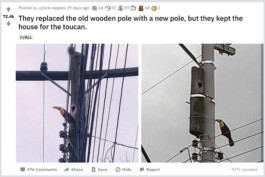
Transposed nesting cavity, c. 2020
An online post documents the relocation of a toucan’s nest by a Brazilian electrical worker named Joilson Brites Antunes. The bird quickly adapted to the new pole and continued to use the transposed nesting cavity.
The practice of cutting out sections of wooden utility poles that contain active bird nests and reattaching these sections to newly installed poles is a formal wildlife-protection procedure used by utility companies. This method is widely documented in regions where cavity-nesting birds such as woodpeckers, owls, and kestrels excavate or occupy cavities in wooden distribution poles. When a pole needs replacement, crews remove the section of wood containing the nest cavity and fix it to the new pole at a comparable height and orientation, allowing the birds to continue nesting with minimal disruption and ensuring compliance with wildlife legislation.
Although standard within the utility sector, this practice has become a recurring motif in social media, where images of visibly cut and reattached nest sections often misinterpret the practice as improvised or eccentric maintenance work.
In Latin American meme culture, the image is fre-quently paired with captions such as “los pájaros pagan renta” (the birds pay rent), framing the relocated cavity as if it were formal housing stock.
When nest-cavity sections are transferred from an old wooden utility pole to a new one, they typically remain in place for the full lifespan of the replacement pole, which is usually 25 – 40 years depending on climate, wood treatment, and local maintenance cycles. Utility companies normally do not remove the transplanted section unless the birds abandon it, or it becomes structurally unsafe.
Many of the cavities continue to be used for years after transfer. Woodpeckers and owls often resume occupancy immediately in the next breeding season, especially if the block was reattached at the same height and orientation.
In Scandinavia, forestry-linked utilities describe situations where multiple cavities from heavily used poles were transferred to a single new pole, resulting in stacked blocks that became local curiosities and informal landmarks. Although visually striking, these structures tend to function reliably and unobtrusively, becoming a routine — if slightly unusual — component of modern wildlife-compliant infrastructure.
4.4
Transposed Nesting Cavity
Transposed nesting cavity, c. 2020
An online post documents the relocation of a toucan’s nest by a Brazilian electrical worker named Joilson Brites Antunes. The bird quickly adapted to the new pole and continued to use the transposed nesting cavity.
The practice of cutting out sections of wooden utility poles that contain active bird nests and reattaching these sections to newly installed poles is a formal wildlife-protection procedure used by utility companies. This method is widely documented in regions where cavity-nesting birds such as woodpeckers, owls, and kestrels excavate or occupy cavities in wooden distribution poles. When a pole needs replacement, crews remove the section of wood containing the nest cavity and fix it to the new pole at a comparable height and orientation, allowing the birds to continue nesting with minimal disruption and ensuring compliance with wildlife legislation.
Although standard within the utility sector, this practice has become a recurring motif in social media, where images of visibly cut and reattached nest sections often misinterpret the practice as improvised or eccentric maintenance work.
In Latin American meme culture, the image is fre-quently paired with captions such as “los pájaros pagan renta” (the birds pay rent), framing the relocated cavity as if it were formal housing stock.
When nest-cavity sections are transferred from an old wooden utility pole to a new one, they typically remain in place for the full lifespan of the replacement pole, which is usually 25 – 40 years depending on climate, wood treatment, and local maintenance cycles. Utility companies normally do not remove the transplanted section unless the birds abandon it, or it becomes structurally unsafe.
Many of the cavities continue to be used for years after transfer. Woodpeckers and owls often resume occupancy immediately in the next breeding season, especially if the block was reattached at the same height and orientation.
In Scandinavia, forestry-linked utilities describe situations where multiple cavities from heavily used poles were transferred to a single new pole, resulting in stacked blocks that became local curiosities and informal landmarks. Although visually striking, these structures tend to function reliably and unobtrusively, becoming a routine — if slightly unusual — component of modern wildlife-compliant infrastructure.