3.4
Red Snapper
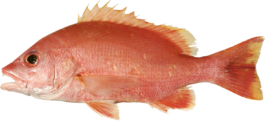
Indonesian snapper (Lutjanus bitaeniatus), 2025
Vomerine tooth patch with medial posterior extension with a relatively deep body and somewhat pointed snout. Source: fishider.org
The snapper family (Lutjanidae) contains ~110 species worldwide, many of which are red or reddish and commonly referred to as “red snapper.”
In practice, 20 – 30 different species are sold globally under the name red snapper. This mislabelling is well documented and is one of the most common cases of seafood name substitution, or “commercial standardisation of species identity.”
The snapper family is one of the world’s most recognisable and sought-after reef fish, admired for its bright scales, firm texture, and sweetness. Fished extensively across the Indo-Pacific and Atlantic regions, it thrives along warm, shallow coastlines where coral and mangroves meet. It is landed from both small wooden boats and industrial trawlers, supplying local markets and international export chains that stretch to Japan, the US, and Europe. This dual status as both a common food and a high-value export reflects its role in multiple markets.
The snapper family also mirrors the fragility of marine abundance. Overfishing and coral decline have threatened its stocks, prompting new sustainability programmes and aquaculture experiments. This development highlights the evolving relationships between coastal societies and marine ecosystems, influenced by consumption patterns, cultural use, and resource constraints.
The Indonesian snapper (Lutjanus bitaeniatus) is relatively abundant and forms part of everyday coastal diets in the archipelago, prepared through grilling, steaming, or use in curries. Beyond its culinary appeal, the fish carries symbolic value: its vivid colour evokes prosperity and good fortune, making it a favoured dish for festive gatherings and ceremonies.
In the following pages, you can read a brief summary of the coconut-processing and shipping company N.V. Insulinde. Disgruntled workers at the company’s Indonesian sites were known to occasionally “spike” shipments of coconut products bound for the Netherlands. This was done by throwing a fish into a shipment, deliberately contaminating and ruining entire batches of stock in the process. Such actions constituted one of the few available forms of resistance within a broader colonial system that afforded workers little leverage.
3.4
Red Snapper
Indonesian snapper (Lutjanus bitaeniatus), 2025
Vomerine tooth patch with medial posterior extension with a relatively deep body and somewhat pointed snout. Source: fishider.org
The snapper family (Lutjanidae) contains ~110 species worldwide, many of which are red or reddish and commonly referred to as “red snapper.”
In practice, 20 – 30 different species are sold globally under the name red snapper. This mislabelling is well documented and is one of the most common cases of seafood name substitution, or “commercial standardisation of species identity.”
The snapper family is one of the world’s most recognisable and sought-after reef fish, admired for its bright scales, firm texture, and sweetness. Fished extensively across the Indo-Pacific and Atlantic regions, it thrives along warm, shallow coastlines where coral and mangroves meet. It is landed from both small wooden boats and industrial trawlers, supplying local markets and international export chains that stretch to Japan, the US, and Europe. This dual status as both a common food and a high-value export reflects its role in multiple markets.
The snapper family also mirrors the fragility of marine abundance. Overfishing and coral decline have threatened its stocks, prompting new sustainability programmes and aquaculture experiments. This development highlights the evolving relationships between coastal societies and marine ecosystems, influenced by consumption patterns, cultural use, and resource constraints.
The Indonesian snapper (Lutjanus bitaeniatus) is relatively abundant and forms part of everyday coastal diets in the archipelago, prepared through grilling, steaming, or use in curries. Beyond its culinary appeal, the fish carries symbolic value: its vivid colour evokes prosperity and good fortune, making it a favoured dish for festive gatherings and ceremonies.
In the following pages, you can read a brief summary of the coconut-processing and shipping company N.V. Insulinde. Disgruntled workers at the company’s Indonesian sites were known to occasionally “spike” shipments of coconut products bound for the Netherlands. This was done by throwing a fish into a shipment, deliberately contaminating and ruining entire batches of stock in the process. Such actions constituted one of the few available forms of resistance within a broader colonial system that afforded workers little leverage.