5.3
Paint Factory
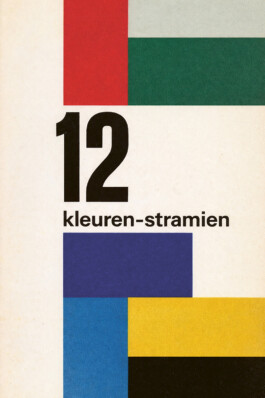
12 kleuren-stramien — Vettewinkel voorstel tot een beperkt kleurgebruik (12-colour scheme — Vettewinkel proposal for a restrained use of colour), 1970
Book cover for the publication, design: Dick Elffers, publisher: H. Vettewinkel & Zonen NV
The paint factory on the Cruquius terrain continues the long history of H. Vettewinkel & Zonen, an Amsterdam firm that began as a city-centre paint mill in 1809 and gradually shifted its production eastward. Hendrik Vettewinkel (1809 – 1878), the son of the founder, was himself a marine and landscape painter, known for his detailed depictions of ships, harbours, and seascapes — an artistic background that sits remarkably close to the firm’s later industrial specialisation.
In 1934, Vettewinkel built a lacquer factory and warehouse on the Cruquiusweg, designed by architects G.J. and A.J. Langhout. As production expanded, additional storeys were added in 1947. A further building was incorporated into the complex around 1958, displaying characteristics of what is often described as “emerging brutalism” — an architectural movement from roughly 1950 to 1980, marked by repetitive geometric forms and the expressive useof raw concrete on façades.
Locally, the site became known as the Vernis- en Verffabriek v/h H. Vettewinkel & Zonen (Varnish and Paint Factory of H. Vettewinkel & Sons), later operating under the name Sigma. Its production focused on varnishes and industrial coatings: traditional oil- and alkyd-based lacquers for wood and metal, alongside increasingly technical products developed for post-war construction and infrastructure.
The firm supplied thousands of litres of Nemitex, a PVAC-based wall paint widely used in modernist interiors for major public buildings. At the other end of the spectrum, it produced seawater-resistant coatings such as Colturiet TCN-100, marketed for the protection of aquarium and marine installations.
Environmental investigations undertaken during the redevelopment of Cruquiuseiland indicate legacy contamination typical of historic paint production. Soil and, in some locations, groundwater revealed elevated concentrations of heavy metals, such as lead and chromium, as well as organic solvents and hydrocarbons associated with early- to mid- twentieth-century paint manufacturing.
5.3
Paint Factory
12 kleuren-stramien — Vettewinkel voorstel tot een beperkt kleurgebruik (12-colour scheme — Vettewinkel proposal for a restrained use of colour), 1970
Book cover for the publication, design: Dick Elffers, publisher: H. Vettewinkel & Zonen NV
The paint factory on the Cruquius terrain continues the long history of H. Vettewinkel & Zonen, an Amsterdam firm that began as a city-centre paint mill in 1809 and gradually shifted its production eastward. Hendrik Vettewinkel (1809 – 1878), the son of the founder, was himself a marine and landscape painter, known for his detailed depictions of ships, harbours, and seascapes — an artistic background that sits remarkably close to the firm’s later industrial specialisation.
In 1934, Vettewinkel built a lacquer factory and warehouse on the Cruquiusweg, designed by architects G.J. and A.J. Langhout. As production expanded, additional storeys were added in 1947. A further building was incorporated into the complex around 1958, displaying characteristics of what is often described as “emerging brutalism” — an architectural movement from roughly 1950 to 1980, marked by repetitive geometric forms and the expressive useof raw concrete on façades.
Locally, the site became known as the Vernis- en Verffabriek v/h H. Vettewinkel & Zonen (Varnish and Paint Factory of H. Vettewinkel & Sons), later operating under the name Sigma. Its production focused on varnishes and industrial coatings: traditional oil- and alkyd-based lacquers for wood and metal, alongside increasingly technical products developed for post-war construction and infrastructure.
The firm supplied thousands of litres of Nemitex, a PVAC-based wall paint widely used in modernist interiors for major public buildings. At the other end of the spectrum, it produced seawater-resistant coatings such as Colturiet TCN-100, marketed for the protection of aquarium and marine installations.
Environmental investigations undertaken during the redevelopment of Cruquiuseiland indicate legacy contamination typical of historic paint production. Soil and, in some locations, groundwater revealed elevated concentrations of heavy metals, such as lead and chromium, as well as organic solvents and hydrocarbons associated with early- to mid- twentieth-century paint manufacturing.