5.1
Fire-Protection Technology
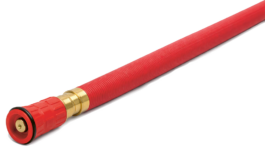
Generic modern firehose (real and fictitious product assembly), 2025
Designed for high-pressure water delivery in fixed fire-safety installations, it is commonly mounted on reels within industrial and municipal buildings. Author: James Beckett
Founded in 1910 on the Cruquiusweg, NV Noord-Hollandsche Asbestfabriek v/h J. de Boer & Co began as a producer of insulation materials for maritime and industrial clients. Its early decades centred on fabricating heat-resistant components — initially asbestos-based — serving shipyards and engine-room contractors active throughout the Amsterdam harbour.
With the adoption of the Ajax brand name in 1920, the company shifted from generic insulation supply towards the specialised field of fire-protection technology, positioning Cruquiuseiland as a key node in the emerging safety-equipment sector.
In the mid-twentieth century, Ajax steadily broadened its technical capacity. While its well-known firehoses evolved from mineral yarn to modern synthetic jackets, the factory simultaneously developed workshops for metal fabrication, hose-binding, coating, and pressure testing. This allowed the Cruquius site to become a multifunctional production and service centre supplying hoses, nozzles, reels, extinguishers, and custom fittings for maritime, industrial, and port-infrastructure clients. The waterfront location — near quays still busy with cargo and ship repair — meant vessels could deliver worn equipment directly to Ajax for refurbishment, a service that became one of the firm’s defining strengths.
By the 1960s the company was also training crews and maintenance staff on site, staging demonstrations and handling exercises among the industrial surroundings of the island. As Dutch and European standards tightened, Ajax incorporated design offices and testing bays into the complex, producing technical documentation and compliance protocols used nationwide.
The Ajax logo originated in Amsterdam, where both the Cruquius fire-safety company and a newly founded football club independently adopted Ajax the Greek hero as a symbol of strength and vigilance. Their shared imagery reflects a broader cultural sampling of classical mythology of the time.
Ajax’s long industrial presence left a significant material legacy. During housing redevelopment in the 2010s and 2020s, remediation works on Cruquius-eiland addressed asbestos contamination typical of early-twentieth-century manufacturing sites, including residues associated with fire-safety and insulation industries active there.
5.1
Fire-Protection Technology
Generic modern firehose (real and fictitious product assembly), 2025
Designed for high-pressure water delivery in fixed fire-safety installations, it is commonly mounted on reels within industrial and municipal buildings. Author: James Beckett
Founded in 1910 on the Cruquiusweg, NV Noord-Hollandsche Asbestfabriek v/h J. de Boer & Co began as a producer of insulation materials for maritime and industrial clients. Its early decades centred on fabricating heat-resistant components — initially asbestos-based — serving shipyards and engine-room contractors active throughout the Amsterdam harbour.
With the adoption of the Ajax brand name in 1920, the company shifted from generic insulation supply towards the specialised field of fire-protection technology, positioning Cruquiuseiland as a key node in the emerging safety-equipment sector.
In the mid-twentieth century, Ajax steadily broadened its technical capacity. While its well-known firehoses evolved from mineral yarn to modern synthetic jackets, the factory simultaneously developed workshops for metal fabrication, hose-binding, coating, and pressure testing. This allowed the Cruquius site to become a multifunctional production and service centre supplying hoses, nozzles, reels, extinguishers, and custom fittings for maritime, industrial, and port-infrastructure clients. The waterfront location — near quays still busy with cargo and ship repair — meant vessels could deliver worn equipment directly to Ajax for refurbishment, a service that became one of the firm’s defining strengths.
By the 1960s the company was also training crews and maintenance staff on site, staging demonstrations and handling exercises among the industrial surroundings of the island. As Dutch and European standards tightened, Ajax incorporated design offices and testing bays into the complex, producing technical documentation and compliance protocols used nationwide.
The Ajax logo originated in Amsterdam, where both the Cruquius fire-safety company and a newly founded football club independently adopted Ajax the Greek hero as a symbol of strength and vigilance. Their shared imagery reflects a broader cultural sampling of classical mythology of the time.
Ajax’s long industrial presence left a significant material legacy. During housing redevelopment in the 2010s and 2020s, remediation works on Cruquius-eiland addressed asbestos contamination typical of early-twentieth-century manufacturing sites, including residues associated with fire-safety and insulation industries active there.