5.5
Coffee
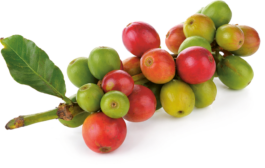
Coffea robusta (C. canephora var. robusta), date unknown
Coffea robusta (robust coffee) represents between 40% and 45% of global coffee production. Generic stock image, Author: unknown
In the late nineteenth century, coffee production in the Dutch East Indies (present-day Indonesia) entered a period of transition shaped by both agricultural pressures and expanding global demand. For much of the century, arabica was the principal crop, grown at elevations of 1.000 – 1.500 metres in the volcanic highlands of Java, Sumatra, and parts of Sulawesi. These conditions proved ideal for producing high-quality beans, but they required attentive cultivation: meticulous pruning, careful shade management, and the selective picking of ripe cherries. Processing remained labour-intensive, with cherries pulped, fermented, washed, and sundried before hulling and sorting.
This system was disrupted by the arrival of coffee-leaf rust (Hemileia vastatrix), which reached Java in the 1870s and spread across the archipelago in the decades that followed.
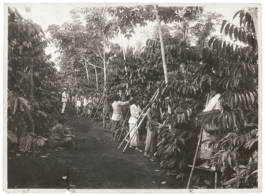
“Workers harvesting coffee on a plantation in the Dutch East Indies,” 1933
Photograph: N.V. Photografisch Atelier Kurkdjian, Nationaal Archief, Fotocollectie Spaarnestad Onderwerpen
The epidemic devastated arabica plantations, leading many estates to adopt robusta, a species more resistant to disease and lower in cultivation cost. Although robusta offered resilience and higher yields, it produced a stronger, less delicate cup, and its growing prominence gradually altered the taste profiles available to European markets.
For the Dutch market, a major shift occurred with the completion of the Entrepothaven on Cruquiuseiland around 1897 – 1900. This new harbour basin, purpose-built for bonded storage, became one of Amsterdam’s principal gateways for colonial commodities, with coffee among its most valuable imports.
Coinciding with the expansion of these Dutch harbour facilities, West Sumatra developed into a significant coffee-producing region. Administrative consolidation enabled the integration of the Minangkabau highlands into export circuits just as coffee-leaf rust ravaged Java.
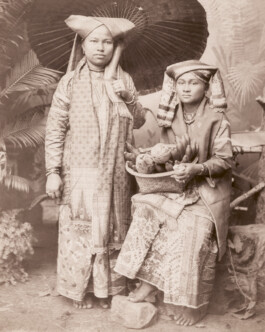
Minangkabau women in Palembayan near Maninjau, c. 1890–1910
Photograph: Christiaan Benjamin Nieuwenhuis, Collection Wereldmuseum (formerly Tropenmuseum), Amsterdam
With the end of forced cultivation, private estates expanded, but in West Sumatra the main drivers were Minangkabau smallholders, who rapidly adopted coffee as a profitable crop. Their output flowed into the colonial trade system, helping to anchor West Sumatra’s prominence in the late-nineteenth-century coffee economy.
The Minangkabau people of West Sumatra, are renowned for having the world’s largest matrilineal society. In this system, property, family names, and lineage are passed down through women, giving them a central role in social and economic life. While men traditionally handle political and religious leadership, women control land and inheritance, ensuring stability within the community. This unique structure is deeply intertwined with their cultural philosophy of adat (customary law) and Islamic values, creating a balance between tradition and faith. The matriarchal framework fosters strong kinship ties and emphasises collective wellbeing over individual ownership.
With the end of forced cultivation, private estates expanded, but in West Sumatra the main drivers were Minangkabau smallholders, who rapidly adopted coffee as a profitable crop. Their output flowed into the colonial trade system, helping to anchor West Sumatra’s prominence in the late-nineteenth-century coffee economy.
Dutch administrators attempted to codify local customs, but this created a hybrid system where colonial governance reinforced male authority in public spheres, yet women continued to dominate inheritance and domestic decision-making. The tension between colonial law and indigenous matriarchy became a site of negotiation, shaping resistance movements and cultural identity.
Products from the Minangkabau region arrived in large volumes at Cruquiuseiland. The long brick warehouses lining the Entrepothaven — some exten-ding more than 200 metres — served as the primary storage facilities for these goods. Their upper floors, designed for optimal airflow and dryness, were stacked with jute sacks of coffee awaiting auction, sampling, or forwarding. The scale was immense: by the early twentieth century, the Dutch East Indies supplied up to 90 % of the coffee handled in Amsterdam, much of it destined for re-export to Germany, Scandinavia, and Central Europe.
During the interwar period, global supply disruptions and rising prices encouraged roasters to broaden their sourcing and to experiment with new blends. After Indonesian independence, Dutch import patterns diversified further, drawing from Brazil, Colombia, Central America, and East Africa.
Much of this coffee continued to pass through the Entrepothaven’s bonded system until the rise of containerisation in the 1970s reshaped port logistics. Through these last decades, Cruquiuseiland remained a central node in Amsterdam’s coffee economy, its monumental warehouses bearing the imprint of the global trade they once sustained.
5.5
Coffee
Coffea robusta (C. canephora var. robusta), date unknown
Coffea robusta (robust coffee) represents between 40% and 45% of global coffee production. Generic stock image, Author: unknown
In the late nineteenth century, coffee production in the Dutch East Indies (present-day Indonesia) entered a period of transition shaped by both agricultural pressures and expanding global demand. For much of the century, arabica was the principal crop, grown at elevations of 1.000 – 1.500 metres in the volcanic highlands of Java, Sumatra, and parts of Sulawesi. These conditions proved ideal for producing high-quality beans, but they required attentive cultivation: meticulous pruning, careful shade management, and the selective picking of ripe cherries. Processing remained labour-intensive, with cherries pulped, fermented, washed, and sundried before hulling and sorting.
This system was disrupted by the arrival of coffee-leaf rust (Hemileia vastatrix), which reached Java in the 1870s and spread across the archipelago in the decades that followed.
“Workers harvesting coffee on a plantation in the Dutch East Indies,” 1933
Photograph: N.V. Photografisch Atelier Kurkdjian, Nationaal Archief, Fotocollectie Spaarnestad Onderwerpen
The epidemic devastated arabica plantations, leading many estates to adopt robusta, a species more resistant to disease and lower in cultivation cost. Although robusta offered resilience and higher yields, it produced a stronger, less delicate cup, and its growing prominence gradually altered the taste profiles available to European markets.
For the Dutch market, a major shift occurred with the completion of the Entrepothaven on Cruquiuseiland around 1897 – 1900. This new harbour basin, purpose-built for bonded storage, became one of Amsterdam’s principal gateways for colonial commodities, with coffee among its most valuable imports.
Coinciding with the expansion of these Dutch harbour facilities, West Sumatra developed into a significant coffee-producing region. Administrative consolidation enabled the integration of the Minangkabau highlands into export circuits just as coffee-leaf rust ravaged Java.
Minangkabau women in Palembayan near Maninjau, c. 1890–1910
Photograph: Christiaan Benjamin Nieuwenhuis, Collection Wereldmuseum (formerly Tropenmuseum), Amsterdam
With the end of forced cultivation, private estates expanded, but in West Sumatra the main drivers were Minangkabau smallholders, who rapidly adopted coffee as a profitable crop. Their output flowed into the colonial trade system, helping to anchor West Sumatra’s prominence in the late-nineteenth-century coffee economy.
The Minangkabau people of West Sumatra, are renowned for having the world’s largest matrilineal society. In this system, property, family names, and lineage are passed down through women, giving them a central role in social and economic life. While men traditionally handle political and religious leadership, women control land and inheritance, ensuring stability within the community. This unique structure is deeply intertwined with their cultural philosophy of adat (customary law) and Islamic values, creating a balance between tradition and faith. The matriarchal framework fosters strong kinship ties and emphasises collective wellbeing over individual ownership.
With the end of forced cultivation, private estates expanded, but in West Sumatra the main drivers were Minangkabau smallholders, who rapidly adopted coffee as a profitable crop. Their output flowed into the colonial trade system, helping to anchor West Sumatra’s prominence in the late-nineteenth-century coffee economy.
Dutch administrators attempted to codify local customs, but this created a hybrid system where colonial governance reinforced male authority in public spheres, yet women continued to dominate inheritance and domestic decision-making. The tension between colonial law and indigenous matriarchy became a site of negotiation, shaping resistance movements and cultural identity.
Products from the Minangkabau region arrived in large volumes at Cruquiuseiland. The long brick warehouses lining the Entrepothaven — some exten-ding more than 200 metres — served as the primary storage facilities for these goods. Their upper floors, designed for optimal airflow and dryness, were stacked with jute sacks of coffee awaiting auction, sampling, or forwarding. The scale was immense: by the early twentieth century, the Dutch East Indies supplied up to 90 % of the coffee handled in Amsterdam, much of it destined for re-export to Germany, Scandinavia, and Central Europe.
During the interwar period, global supply disruptions and rising prices encouraged roasters to broaden their sourcing and to experiment with new blends. After Indonesian independence, Dutch import patterns diversified further, drawing from Brazil, Colombia, Central America, and East Africa.
Much of this coffee continued to pass through the Entrepothaven’s bonded system until the rise of containerisation in the 1970s reshaped port logistics. Through these last decades, Cruquiuseiland remained a central node in Amsterdam’s coffee economy, its monumental warehouses bearing the imprint of the global trade they once sustained.