2.3
PurpleAir
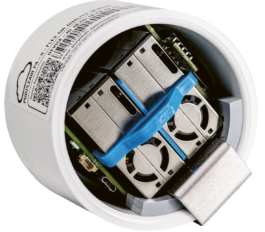
PurpleAir Flex — Air Quality Monitor, 2026
The PurpleAir Flex is designed for residential to industrial users looking to collect real-time PM2.5 data. An LED displays AQI information at a glance, and a modular design provides access to internals, including an SD logger for offline data collection. Source: purpleair.com/products/purpleair-flex
The PurpleAir sensor has become one of the world’s most widely used low-cost air quality monitors, particularly prized for its robust build, simplicity, and high precision for its price point. Inside a PurpleAir sits dual laser particle counters (often using Plantower PM sensor modules), which continuously count particles in the air, especially fine particulate matter (PM2.5), which is a critical air pollutant. Because it continuously reports real-time particle counts and converts them into estimated mass concentrations, PurpleAir can deliver minute-by-minute air-quality data to a globally accessible map.
PurpleAir monitors, when properly sited and calibrated, have been shown to provide surprisingly accurate PM2.5 estimates. Their strength lies not only in the hardware, but in their widespread deployment: by placing many sensors across a city or region, users can build a dense, high-resolution network that reveals local pollution hot spots and temporal variations that expensive government monitors might miss.
Owning your own sensor, therefore, means having direct, real-time insight into the air you and your neighbours breathe. It’s a growing trend in citizen science and community-driven environmental monitoring. This bottom-up approach can supplement official air-quality data, especially in places where regulatory monitoring is sparse, unevenly distributed, or slow to update.
On a larger scale, widespread use of devices like PurpleAir is part of an emergent movement towards decentralising environmental surveillance. Rather than relying solely on a handful of government-run stations, communities can create many “nodes” in a network, making air pollution visible, personal, and locally actionable.
In an era of growing concern over urban air quality, wildfire smoke, and industrial emissions, such grassroots monitoring empowers individuals with data and helps shape a more distributed, democratic environmental awareness.
2.3
PurpleAir
PurpleAir Flex — Air Quality Monitor, 2026
The PurpleAir Flex is designed for residential to industrial users looking to collect real-time PM2.5 data. An LED displays AQI information at a glance, and a modular design provides access to internals, including an SD logger for offline data collection. Source: purpleair.com/products/purpleair-flex
The PurpleAir sensor has become one of the world’s most widely used low-cost air quality monitors, particularly prized for its robust build, simplicity, and high precision for its price point. Inside a PurpleAir sits dual laser particle counters (often using Plantower PM sensor modules), which continuously count particles in the air, especially fine particulate matter (PM2.5), which is a critical air pollutant. Because it continuously reports real-time particle counts and converts them into estimated mass concentrations, PurpleAir can deliver minute-by-minute air-quality data to a globally accessible map.
PurpleAir monitors, when properly sited and calibrated, have been shown to provide surprisingly accurate PM2.5 estimates. Their strength lies not only in the hardware, but in their widespread deployment: by placing many sensors across a city or region, users can build a dense, high-resolution network that reveals local pollution hot spots and temporal variations that expensive government monitors might miss.
Owning your own sensor, therefore, means having direct, real-time insight into the air you and your neighbours breathe. It’s a growing trend in citizen science and community-driven environmental monitoring. This bottom-up approach can supplement official air-quality data, especially in places where regulatory monitoring is sparse, unevenly distributed, or slow to update.
On a larger scale, widespread use of devices like PurpleAir is part of an emergent movement towards decentralising environmental surveillance. Rather than relying solely on a handful of government-run stations, communities can create many “nodes” in a network, making air pollution visible, personal, and locally actionable.
In an era of growing concern over urban air quality, wildfire smoke, and industrial emissions, such grassroots monitoring empowers individuals with data and helps shape a more distributed, democratic environmental awareness.