2.1
Cleat Hitch Knot
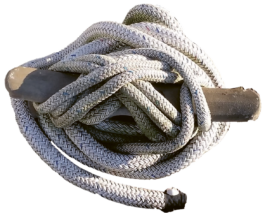
Badly tied cleat hitch knot, 2016
The cleat hitch is often considered a simple knot, yet it is just as easy to tie incorrectly. Frequent errors include wrapping the line too many times around the cleat, failing to make the final locking turn that secures the rope, leaving the knot insufficiently tightened, or twisting the finishing turn in the wrong direction. Author: Herb Benavent, source: riggingdoctor.com
The cleat hitch is a foundational knot in maritime culture, emerging alongside the widespread adoption of the deck cleat in European and later global seafaring during the eighteenth and nineteenth centuries. As ships evolved from wooden rigs to industrialised vessels, the need for a fast, intuitive method of securing lines — especially during docking — made the cleat hitch a universal skill among sailors. It became part of the shared, practical vocabulary of seamanship: a knot learned early, used daily, and valued for its reliability. In harbours, marinas, and fishing communities, the gesture of tying a cleat hitch is almost ritualistic, a familiar motion linking generations of maritime workers.
Its effectiveness lies in the physics of alternating tension and friction.
The initial full turn around the base of the cleat absorbs most of the load; this single wrap prevents the rope from slipping even before the figure-eight pattern is added. The subsequent crossing turns create opposing friction angles, so the line effectively “locks” itself when pulled. The final inverted loop, or locking hitch, introduces a downward bite that resists cyclic loads from waves, wind, and vessel movement. Despite this mechanical stability, the knot remains easily releasable because the friction is distributed rather than concentrated in a single point.
These properties make the cleat hitch exceptionally suited to nautical use: it is secure under variable loads, quick to adjust, and unlikely to jam, even after heavy strain. Its simplicity and reliability have ensured its place as one of the most enduring knots in seafaring practice.
2.1
Cleat Hitch Knot
Badly tied cleat hitch knot, 2016
The cleat hitch is often considered a simple knot, yet it is just as easy to tie incorrectly. Frequent errors include wrapping the line too many times around the cleat, failing to make the final locking turn that secures the rope, leaving the knot insufficiently tightened, or twisting the finishing turn in the wrong direction. Author: Herb Benavent, source: riggingdoctor.com
The cleat hitch is a foundational knot in maritime culture, emerging alongside the widespread adoption of the deck cleat in European and later global seafaring during the eighteenth and nineteenth centuries. As ships evolved from wooden rigs to industrialised vessels, the need for a fast, intuitive method of securing lines — especially during docking — made the cleat hitch a universal skill among sailors. It became part of the shared, practical vocabulary of seamanship: a knot learned early, used daily, and valued for its reliability. In harbours, marinas, and fishing communities, the gesture of tying a cleat hitch is almost ritualistic, a familiar motion linking generations of maritime workers.
Its effectiveness lies in the physics of alternating tension and friction.
The initial full turn around the base of the cleat absorbs most of the load; this single wrap prevents the rope from slipping even before the figure-eight pattern is added. The subsequent crossing turns create opposing friction angles, so the line effectively “locks” itself when pulled. The final inverted loop, or locking hitch, introduces a downward bite that resists cyclic loads from waves, wind, and vessel movement. Despite this mechanical stability, the knot remains easily releasable because the friction is distributed rather than concentrated in a single point.
These properties make the cleat hitch exceptionally suited to nautical use: it is secure under variable loads, quick to adjust, and unlikely to jam, even after heavy strain. Its simplicity and reliability have ensured its place as one of the most enduring knots in seafaring practice.