1.5
Wine
Wijn Terminal Roders B.V., 2026
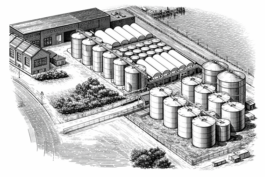
Digital rendering of former location. Image of the former wine tank park at Cruquiusweg 67. Author: James Beckett
At the centre of Cruquiuseiland’s industrial waterfront once stood one of the Netherlands’ most distinctive bulk-wine terminals: the complex operated by Wijn Terminal Roders B.V., whose origins trace back to 1904. For much of the twentieth century this site — recognisable by its forest of tall steel silos — served as a major node in the Dutch and European wine trade. From its base on the Cruquiusweg, Roders specialised in the large-scale import, storage, blending, and bottling of wines arriving from across Europe and beyond.
The company imported substantial volumes of bulk wine from France, Italy, Spain, and Chile, along with aromatised and fortified products that had become popular on the Dutch market. These arrived not in barrels but in modern tankers and tank-containers, allowing Roders to move and process wine in industrial quantities.
Roders’ early business model was logistical and infrastructural, not viticultural. The company acted as an intermediary between overseas producers, shipping companies, and Northern European distributors.
The facility’s tank park, with a capacity of roughly 22 million litres, enabled large consignments to be held, stabilised, and blended before bottling or onward dispatch. At its height, the Cruquius terrain contained around forty steel wine silos, linked by pumps, pipework and enclosed loading bays.
Roders produced several in-house brands — among them Ceccarelli Vermouth, Porte d’Or, Tindella Vermouth, and Torero aromatised fruit wine — while also operating as a contract bottler for other distributors. Wine stored in the silos was transferred to the adjoining bottling works, where it was filled, labelled, and prepared for both domestic sale and European export. The firm’s network eventually extended beyond the EU, with distribution reaching as far as Russia and South Korea.
Changes in regulations during the early 2000s brought an end to the use of large outdoor silos for wine storage, and the tanks at Cruquiuseiland were gradually decommissioned. In recent redevelopment, three of the original steel vessels were preserved and transformed into residential “silo villas,” leaving an architectural reminder of the island’s former life as a hub for global bulk-wine logistics.
1.5
Wine
Wijn Terminal Roders B.V., 2026
Digital rendering of former location. Image of the former wine tank park at Cruquiusweg 67. Author: James Beckett
At the centre of Cruquiuseiland’s industrial waterfront once stood one of the Netherlands’ most distinctive bulk-wine terminals: the complex operated by Wijn Terminal Roders B.V., whose origins trace back to 1904. For much of the twentieth century this site — recognisable by its forest of tall steel silos — served as a major node in the Dutch and European wine trade. From its base on the Cruquiusweg, Roders specialised in the large-scale import, storage, blending, and bottling of wines arriving from across Europe and beyond.
The company imported substantial volumes of bulk wine from France, Italy, Spain, and Chile, along with aromatised and fortified products that had become popular on the Dutch market. These arrived not in barrels but in modern tankers and tank-containers, allowing Roders to move and process wine in industrial quantities.
Roders’ early business model was logistical and infrastructural, not viticultural. The company acted as an intermediary between overseas producers, shipping companies, and Northern European distributors.
The facility’s tank park, with a capacity of roughly 22 million litres, enabled large consignments to be held, stabilised, and blended before bottling or onward dispatch. At its height, the Cruquius terrain contained around forty steel wine silos, linked by pumps, pipework and enclosed loading bays.
Roders produced several in-house brands — among them Ceccarelli Vermouth, Porte d’Or, Tindella Vermouth, and Torero aromatised fruit wine — while also operating as a contract bottler for other distributors. Wine stored in the silos was transferred to the adjoining bottling works, where it was filled, labelled, and prepared for both domestic sale and European export. The firm’s network eventually extended beyond the EU, with distribution reaching as far as Russia and South Korea.
Changes in regulations during the early 2000s brought an end to the use of large outdoor silos for wine storage, and the tanks at Cruquiuseiland were gradually decommissioned. In recent redevelopment, three of the original steel vessels were preserved and transformed into residential “silo villas,” leaving an architectural reminder of the island’s former life as a hub for global bulk-wine logistics.